WHAT IS THE MENTAL HEALTH SYSTEM?
The mental health system is part of the wider health and social care system in England and Wales. It contains services and staff who provide care, treatment and support for people when they are mentally unwell.

It includes primary care services, such as General Practitioners (GPs), who are often the first point of contact when someone is experiencing a mental health problem. GPs can prescribe medication or make a referral for psychological support, such as counselling or therapy. In more serious cases, they can also refer patients on to other services, such as a Community Mental Health Team, Crisis or Home Treatment team, for specialist support. These teams often consist of different professionals, including Community Psychiatric Nurses (or CPNs for short), social workers and psychologists, who work together to provide care and support in the community.
In addition to mental health care in the community, mental health treatment can be provided in a psychiatric unit or hospital.
There are a mixture of NHS and private/ independent hospitals in England and Wales who provide in-patient assessment and treatment services. Most patients consent to being admitted to a psychiatric hospital for treatment, in the same way as patients who are admitted for treatment for a physical illness or injury. Care and treatment in hospital is provided by staff from different specialisms, including mental health nurses, social workers, consultant psychiatrists and psychologists, and health care assistants. They often work together as part of a Multidisciplinary team (or MDT, for short).
When someone is seriously mentally unwell and they are thought to be a risk to themselves or others, they may be admitted to a psychiatric hospital for assessment or treatment under the Mental Health Act 1983. This is a law that allows mental health professionals to compulsorily admit someone to a psychiatric unit or hospital (i.e. they can be admitted against their will). They may be admitted to a secure (locked) ward in this situation, as they are thought to be at risk.
- Admission to hospital under the Mental Health Act
When a person is detained (or ‘sectioned’) under the Mental Health Act they will be admitted to a psychiatric hospital or unit for assessment or treatment. An assessment to decide if a person should be admitted will be completed by a team of professionals made up of an Approved Mental Health Professional and two doctors.
There are different sections of the Mental Health Act that can be used to admit a person to hospital. The professionals involved in the assessment will decide which section is most appropriate. The most frequently used section is section 2, which can admit someone to hospital for up to 28 days for assessment and, potentially, treatment. This section is used if further assessment is needed in hospital before a treatment plan is agreed by professionals.
Section 3 can be used to detain a person for an initial 6 months for medical treatment. This section may be used if a treatment plan is already in place, meaning assessment in hospital under section 2 is not necessary. If a person is already known to mental health services or has had prior admissions, it may be that a treatment plan is already known, and a section 3 may be used.
- Discharge and Aftercare under the Mental Health Act
In some circumstances, people are legally entitled to aftercare support following their discharge from hospital. This is set out in section 117 of the Mental Health Act and is often referred to by professionals as ‘section 117 aftercare’.
This aftercare can financially support people with healthcare, social care, and supported living needs that relate to their mental health. This support will continue until health and social care bodies decide it is no longer needed.
Community Mental Health Services are guided by the Community Mental Health Framework (CMHF). This framework aims to provide integrated and personalised community support for users of mental health services, including those who have been discharged from hospital and those entitled to section 117 aftercare. The CMHF replaced the Care Programme Approach (CPA) in 2019. The CPA was the previous model of community mental health support and was criticised for being overly focussed on risk and as varying in its delivery across England and Wales. However, Nearest Relatives have reported that some mental health services are still working with the frameworks of the CPA, rather than the CMHF, which can cause uncertainty and confusion. In these cases, Nearest Relatives can ask the service for details on what framework is being used and how aftercare support will be provided.
Some people are discharged from hospital but continue to be supervised in the community by their Responsible Clinician (the mental health professional in charge of their treatment). This can happen under a Community Treatment Order where a person will continue to be treated in the community and will have certain conditions on their discharge. If their Responsible Clinician thinks that a person requires treatment in hospital for their mental health and is a risk to themselves or other people, or if they think the conditions of discharge are not being followed, the person can be recalled to hospital.
- Experiences of mental health care and the Mental Health Act
Experiences of mental health care and detention under the Mental Health Act are variable. Black people are more likely than White people to be detained under the Mental Health Act. People from ethnically and culturally diverse communities report poor experiences of mental health care. There are many reasons for this, including stigma, distrust and discrimination.
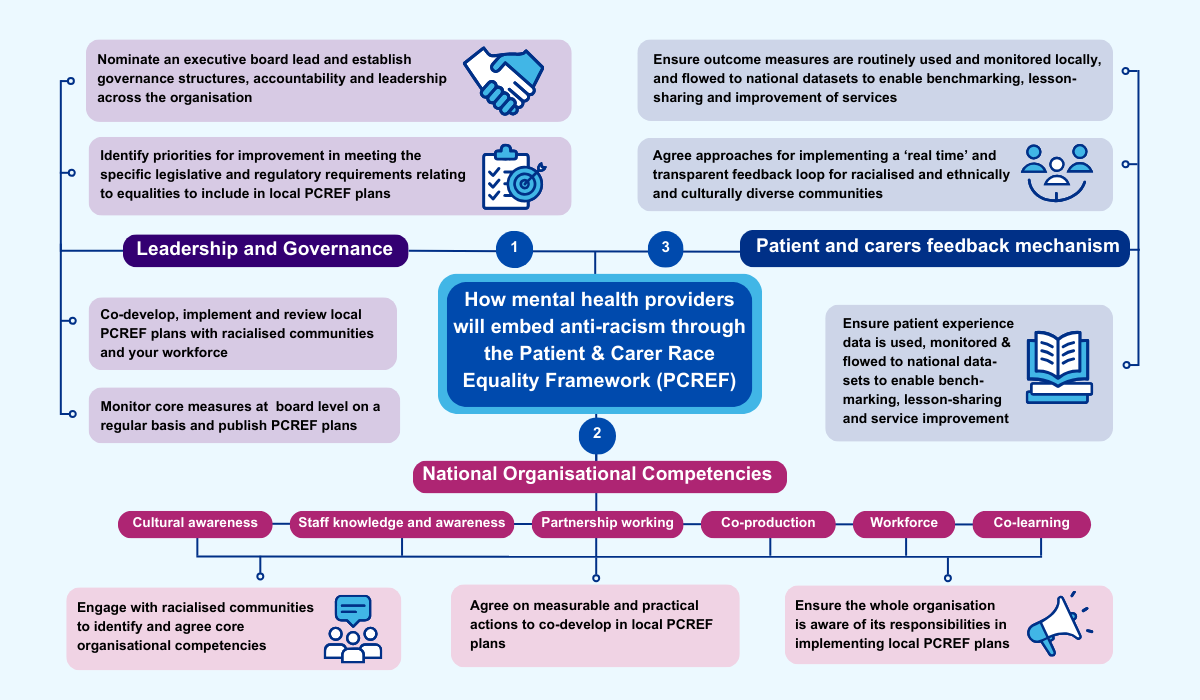
The NHS Patient and Carer Race Equality Framework was launched in 2024 by NHS England to combat this. It is the first anti-racism framework for mental health trusts and mental health providers. It aims to improve access, experiences and mental health outcomes for people from ethnic minority groups and all providers are now required by law to have the framework in place. You can ask healthcare providers about what they are doing to embed the framework when you are speaking to them about your relative’s care.
There are concerns about children and young people’s experiences of mental health care. The Children’s Commissioner produces annual reports on this topic. The latest report found that many children are experiencing long waits to access mental health services, and there is a postcode lottery in children’s access to suitable support for their mental health conditions. Children and young people should be put in touch with the Children and Adolescent Mental Health Services team if they need specialist care and treatment. You can find out how to get mental health support here.
An Independent Review of the Mental Health was carried out in 2018 to look at people’s experiences of the Mental Health Act and how it is working. The review spoke to lots of people who have been treated under the Mental Health Act. It found that people want more control over their treatment and to choose who can support them and get information about them. It made a lot of recommendations about how the Mental Health Act should be changed. You can find out more here about the review and what has been happening to change the law and practice since the report was published. You can also read about what legal changes will happen in future on this website.
WHO’S WHO IN THE MENTAL HEALTH SYSTEM
This section describes the people and professionals you are likely to come across as a Nearest Relative.
The Assessment
- Approved Mental Health Professionals (AMHPs)
Approved Mental Health Professionals are specially trained mental health professionals who are often referred to as AMHPs, for short. They are employed by the Local Authority and have an important role in Mental Health Act assessments, to decide whether the person should be admitted to hospital. They are responsible for coordinating the Mental Health Act assessment and will apply for a person to be admitted. They will also organise the admission to hospital. Most AMHPs are social workers who have had additional specialist training, but they may also be a nurse, occupational therapist, or psychologist.
The AMHP is also responsible for identifying and speaking to a person’s Nearest Relative. This means they are likely to be the first point of contact for a Nearest Relative when their family member is being assessed under the Mental Health Act. Once a person has been admitted to hospital, the AMHP will no longer be the main point of contact, as responsibility will be passed to staff on the ward.
- Doctors
There will normally be two doctors involved in a Mental Health Act assessment. One should be a specially trained psychiatrist, often known as a ‘Section 12 Doctor’ because this training is set out in section 12 of the Mental Health Act. The other should be a doctor that has some knowledge of the person being assessed (such as the person’s GP or their community psychiatrist).
The doctors and AMHP must agree that a person meets the criteria for detention. If they do, the AMHP will make an application for detention to a hospital.
Ward Staff and Settings
People admitted for assessment or treatment under the Mental Health Act will be on a mental health ward.
Some wards are single sex wards and others are mixed. There may also be a mix of patients on the ward, with some there on a voluntary basis, and others will be detained under the Mental Health Act. Some wards will have greater levels of staffing and security depending on the needs of the patient and the risks present. There are also dedicated wards for young adults and children.
AMHPs are responsible for finding a ward with an available bed. They will try and find somewhere local, but this isn’t always possible, and it may be that a bed is found a long way from a person’s home and family. This may be because a specialist ward is needed, such as for young people or for people experiencing an eating disorder. The ward may be in an NHS mental health hospital, or it may be in an independent hospital (the treatment will remain NHS funded). Transport for the patient to the hospital will be provided as part of the admission.
These wards will be staffed by doctors, nurses, occupational therapists, psychologists and health care assistants. Social workers may also be involved in the support given to patients. These professionals work together to provide care and treatment as part of the Multidisciplinary Team (MDT). There are other important staff roles in mental health wards, which include:

- Responsible Clinician
The Responsible Clinician holds overall responsibility for the care of a person detained under the Mental Health Act. They make decisions about treatment and have the power to discharge a patient from hospital. They can prevent a Nearest Relative from discharging a patient in certain circumstances.
A Responsible Clinician must be a mental health professional. It can be a chartered psychologist, occupational therapist, a registered nurse, or social worker, but is usually a psychiatrist (registered doctor).
- Independent Mental Health Advocate (IMHA)
A person is entitled to speak to an Independent Mental Health Advocate if they are detained under the Mental Health Act. An IMHA can help a person understand their rights and can explain the role of the Nearest Relative to them. A Nearest Relative can request that an IMHA visits a patient, but a patient can refuse the support of an IMHA.
The IMHA can visit a person on a ward, view relevant documentation, and speak to professionals, and attend meetings about a person’s care and treatment. They can also support a person to complain if they are unhappy with how they have been treated.
A patient should be informed about their right to access an IMHA when they are admitted to a ward. The services that provide IMHAs vary depending on where in the country a person is detained. Specific information on accessing an IMHA can be requested from ward staff, the Responsible Clinician, or from an AMHP.
More information on the IMHA role is in the ‘Advice’ section, further below on this page and here.
- Other advocacy for carers
If a patient is in an independent hospital there may be other forms of advocacy and support available for Nearest Relatives. For example, Cygnet hospitals have a dedicated Carers Advocacy service for carers of people in one of their mental health hospitals. This is different to patient advocacy as it focused on the needs of carers. More information on this support can be found here.
- Mental Health Act Administrator
Mental Health Act Administrators have an important role to make sure that hospital admissions comply with the Mental Health Act and its Code of Practice. They ensure that documentation about Mental Health Act detention is correct and liaise with wards, professionals, and relatives to organise review and tribunals. They should also ensure that detained patients are made aware of their rights on admission. This information on rights should also be made available to Nearest Relatives.
- Hospital Managers
The Hospital Managers are a panel of 3 people who are appointed by the hospital to consider whether a patient should be discharged from hospital. They are not employed by the hospital and are usually members of the local community. Patients should be given information about how to contact the Hospital Managers when they are admitted to hospital under the Mental Health Act. A patient can ask the Hospital Managers to review their detention at any time. Hospital Managers must review a patient’s detention if the Responsible Clinician has blocked the patient’s Nearest Relative from discharging them (this is often referred to as the Responsible Clinician making a ‘barring report’).
More information about Hospital Managers and the powers they have is available on Mind’s website here.
Leave a comment